
How to Keep an Indoor Cat Active and Happy
· By The Golden Paw Team
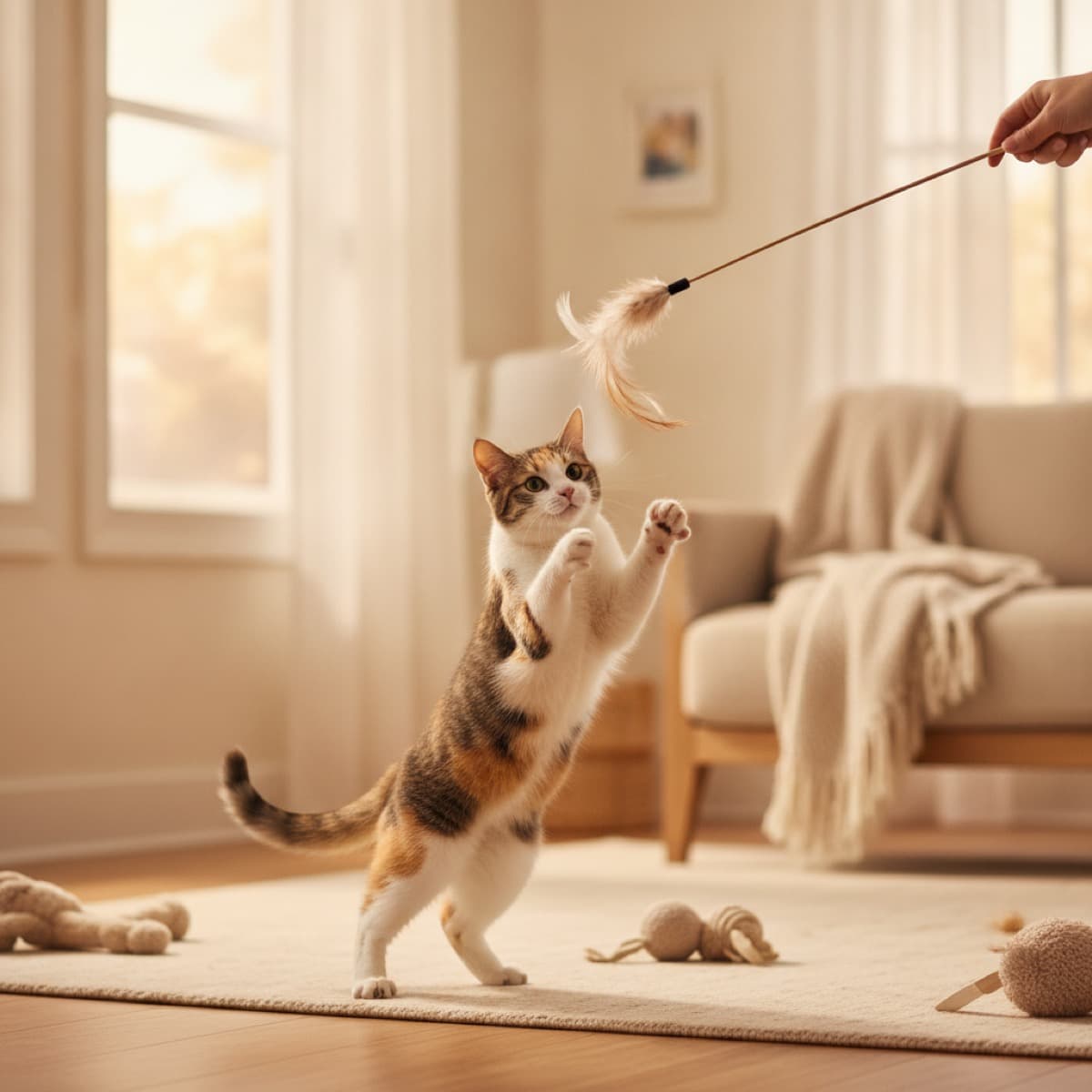
Keeping a cat indoors is one of the kindest things you can do for their safety. Indoor cats avoid traffic, predators, disease, and a long list of outdoor dangers, and they tend to live longer for it. The tradeoff is that four walls can get boring, and a bored cat is often an overweight, restless, or mischievous one.
The fix is enrichment: giving your cat outlets for the natural behaviors they would use outdoors, like hunting, climbing, scratching, and exploring. It does not take a huge budget or a room full of gear, just a bit of intention and a few good tools. This guide covers play routines, the right toys, vertical space, food-based enrichment, and how to read your cat's signals. Golden Paw curates cat toy picks worth a look on Chewy and Amazon, but many of the best ideas here cost little or nothing at all.
Play With a Purpose: Mimic the Hunt
Cats are hunters at heart, and the most satisfying play taps into that instinct. Interactive toys you control, like a wand with a feather or a string toy, let you move the target like real prey: darting, pausing, hiding, then bolting away. That stop-and-go movement is what triggers a cat's stalk-and-pounce drive, far more than a toy dragged in a steady line.
Aim for a couple of short play sessions a day, roughly ten to fifteen minutes each, though every cat is different. Watch for signs of engagement like a swishing tail and locked-in focus, and let the session build to a successful catch so your cat feels the payoff of the hunt rather than endless frustration.
Timing helps too. A play session before mealtime mimics the natural hunt-then-eat cycle, and a good workout in the evening can settle a cat who otherwise gets the late-night zoomies. Always put string and wand toys away after play, since loose string is a swallowing hazard when unsupervised.
The Right Toys, Rotated Often
Cats bore of the same toys quickly, which is why a pile of untouched toys is such a common sight. The trick is not to buy more, but to rotate what you have. Keep most toys put away and bring out just a few at a time, swapping them every week or so. A toy that vanished for two weeks feels brand new when it reappears.
Variety of type matters as much as variety of toy. Small toss-and-chase toys satisfy the chase, crinkle balls and catnip mice invite solo play, and puzzle or treat toys engage the brain. Some cats love a simple cardboard box or a paper bag with the handles removed as much as anything from a store, so do not overlook the free options.
When you do shop, look for well-made toys without small parts that can come loose and be swallowed. Golden Paw curates cat toy picks across these categories on Chewy and Amazon so you can match the toy to what your particular cat enjoys, whether that is chasing, batting, or problem-solving.
Build Up: Vertical Space and Perches
Cats live in three dimensions. In the wild they climb, survey their territory from up high, and retreat to safe vantage points. Giving an indoor cat vertical space turns a flat, boring room into an interesting one and adds a lot of natural movement to their day.
A cat tree is the classic answer, especially one tall enough to climb with a perch near a window. Wall-mounted shelves, a sturdy bookshelf your cat is allowed on, or a cat-friendly window perch all work too. A view of the outdoors, birds, squirrels, and passing activity is genuine entertainment, sometimes called cat television for good reason.
Scratching posts belong in this mix as well. Scratching is a deep-seated need that stretches muscles, keeps claws healthy, and marks territory. Offering sturdy vertical and horizontal scratchers protects your furniture and gives your cat another satisfying, physical outlet. Place them where your cat already likes to hang out rather than tucked away in a corner.
Feed the Brain: Food Puzzles and Foraging
Eating from a bowl takes seconds and engages nothing. Food puzzles and foraging toys change that by making your cat work a little for their food, the way they would while hunting. A treat ball your cat has to roll, a puzzle feeder with compartments, or even a few kibble pieces hidden around a room turns a meal into an activity.
This kind of enrichment burns mental energy, slows down fast eaters, and can help with weight by making food less of a passive experience. You can start with easy puzzles and increase the difficulty as your cat gets the hang of it, so they stay challenged without getting discouraged.
For cats who eat mostly dry food, portioning part of the daily kibble into puzzle feeders is an easy win. Just remember to count those calories as part of the daily total, not as extra, so the enrichment does not tip into overfeeding.
Read Your Cat and Keep It Consistent
The best enrichment plan is the one that fits your particular cat. Some cats are lifelong kittens who want to chase all day; others are content with a couple of short bursts and a sunny perch. Pay attention to what lights your cat up, and lean into it. If a toy is ignored every time, retire it and try a different style.
Signs that a cat needs more activity can include weight gain, restlessness, over-grooming, or acting out, though those can also point to health issues. If your cat's behavior changes noticeably or they seem low in energy, it is worth a vet visit to rule out a medical cause rather than assuming it is boredom.
Consistency beats intensity. A few minutes of focused play every day, a rotating toy box, some height to climb, and a puzzle feeder at mealtime add up to a genuinely happier, healthier indoor cat. It is less about big gestures and more about weaving small chances to hunt, climb, and explore into ordinary days.
Frequently asked questions
- How much exercise does an indoor cat need each day?
- A good target for many cats is a couple of short, active play sessions a day, roughly ten to fifteen minutes each, though it varies by cat, age, and health. The goal is engaged, hunt-style play that gets your cat moving, ideally with a satisfying catch at the end.
- Why does my indoor cat seem bored or restless?
- Indoor cats can lack outlets for natural behaviors like hunting, climbing, and exploring, which leads to boredom, extra weight, or acting out. More interactive play, rotating toys, vertical space, and food puzzles usually help. If the behavior change is sudden, check with your vet to rule out a health issue.
- What are the best toys to keep a cat active?
- Interactive wand and string toys are excellent because you can mimic prey, and puzzle or treat toys engage the mind. Rotating a small selection keeps things fresh, since cats bore of the same toys quickly. Simple boxes and paper bags can be big hits too.
- Do I need a cat tree for an indoor cat?
- You do not strictly need one, but vertical space makes a big difference. A cat tree, wall shelves, or a window perch lets your cat climb, survey its territory, and watch the outdoors, all of which add natural movement and enrichment to an indoor life.
Shop these picks
Found this helpful? Make us a preferred source on Google.
Ready for an exact price?
Get a free, no-pressure in-home estimate. Real numbers for your home, not a phone guess.